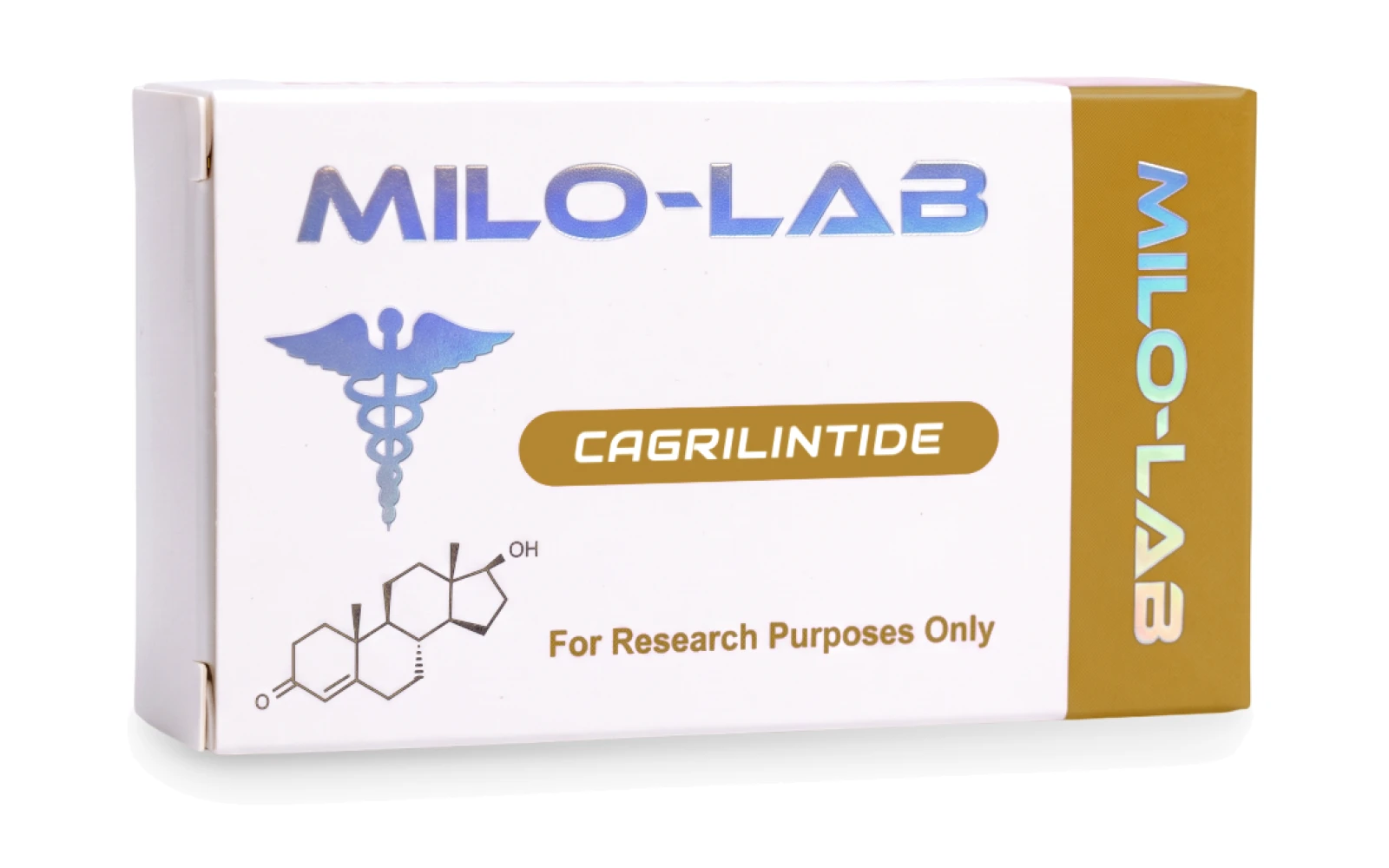
Cagrilintide
Cagrilintide is a long-acting acylated amylin analogue and dual amylin and calcitonin receptor agonist. Research compound, supplied as lyophilised powder.
1 vial · 10 mg total
Checking availability…
Total Price
฿3900


 & more more: Bancontact, Open Banking, Cash App, Afterpay, more coinsCrypto −5%Encrypted checkout
For research & laboratory use only. Not for human consumption.
Shipping: free within Thailand, ฿700 worldwide. Added at checkout. Delivery times & countries
Half-Life
Long-acting (acylated, albumin-bound)
Amylin Receptor Agonist
Non-incretin receptor pathway, separate from GLP-1
Dual Receptor Binding
Amylin receptor complexes and the calcitonin receptor itself
Acylated Long-Acting
Fatty-acid side chain extends plasma exposure over native amylin
Mechanism of Action
Scientific Research
New England Journal of Medicine (2025)
Why Researchers Choose Cagrilintide
Cagrilintide is an acylated amylin analogue studied wherever amylin and calcitonin receptor signalling outside the incretin system is the question:
- Amylin and calcitonin receptor pharmacology
- Non-incretin receptor pathways and mechanism comparisons
- Amylin receptor expression in the area postrema and hypothalamus
- Receptor-level comparison with the GLP-1 receptor pathway
- Aggregation and albumin-binding properties of acylated amylin analogues
How Cagrilintide Works
Amylin is co-secreted with insulin by pancreatic beta cells and signals through amylin and calcitonin receptor complexes in the area postrema and hypothalamus. Native amylin aggregates readily and clears within minutes, which limits its use where extended plasma exposure is needed. Cagrilintide is an acylated analogue engineered around both problems: the sequence resists aggregation, and a lipid side chain binds albumin to extend plasma exposure well beyond that of native amylin.
Amylin receptor signalling operates independently of the GLP-1 receptor, so the two are studied as separate receptor systems.
Cagrilintide vs GLP-1 and Multi-Agonist Peptides
| Cagrilintide | Semaglutide | |
|---|---|---|
| Receptor target | Amylin / calcitonin | GLP-1 |
| Pathway | Non-incretin | Incretin |
| Plasma half-life | Extended (acylated) | Extended (acylated) |
Cagrilintide is the compound of interest when the research question concerns amylin receptor signalling itself, or when the interaction between receptor systems is being modelled.
Storage
Lyophilised vials: store at -20°C, protected from light.
For research purposes only. Not for human consumption.
Product FAQs
Related Products
Research Tools