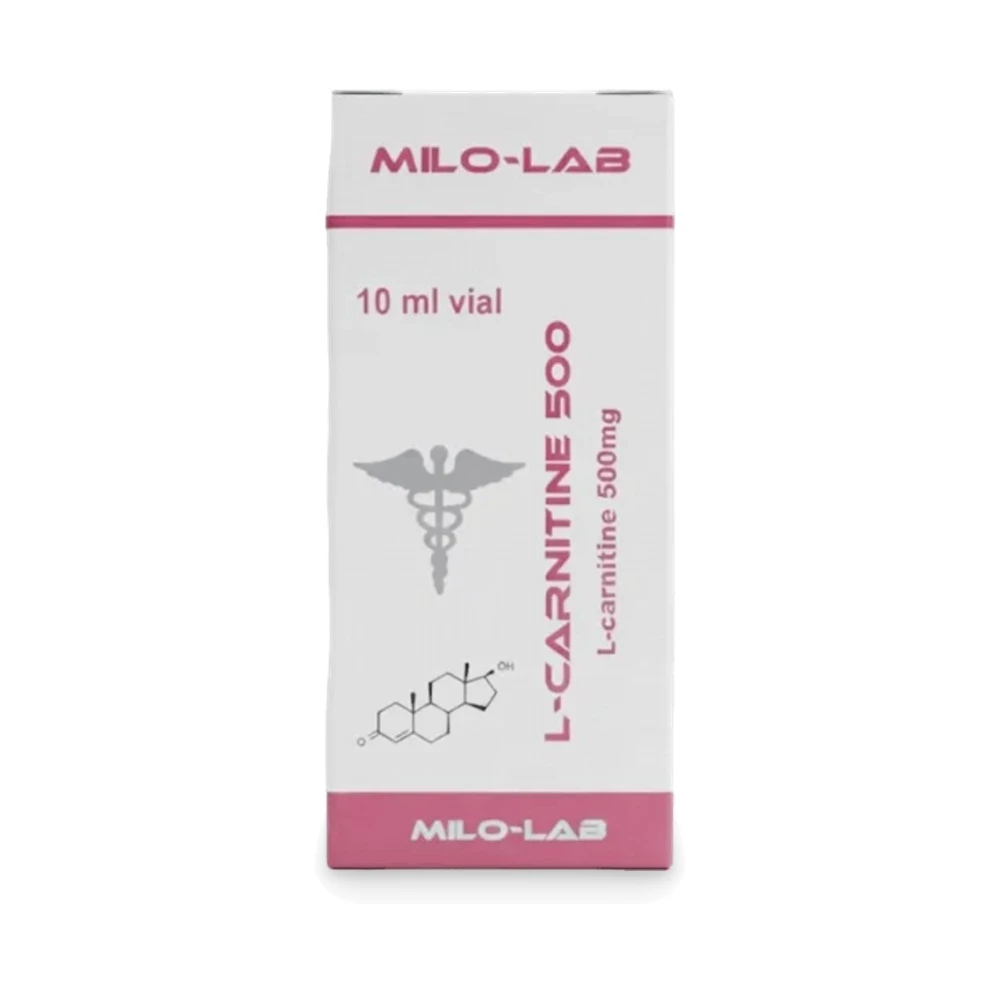
L-Carnitine
L-Carnitine (levocarnitine) is an amino-acid derivative that transports long-chain fatty acids into the mitochondrion for beta-oxidation.
1 vial · 5000 mg total
Checking availability…
Total Price
฿950


 & more more: Bancontact, Open Banking, Cash App, Afterpay, more coinsCrypto −5%Encrypted checkout
For research & laboratory use only. Not for human consumption.
Shipping: free within Thailand, ฿700 worldwide. Added at checkout. Delivery times & countries
Half-Life
~17.4 hours (oral single dose); shorter for parenteral administration
Fatty-Acid Transport
Carries long-chain fatty acids into the mitochondrion for beta-oxidation
Mitochondrial Cofactor
Cofactor in mitochondrial ATP-linked pathways
Exertion Models
Studied for muscle damage markers after exertion (Fielding 2018)
Mechanism of Action
Scientific Research
Nutrients (2018)
Why Researchers Study L-Carnitine
L-Carnitine (levocarnitine) is the biologically active form of carnitine, a small amino-acid derivative the body makes from lysine and methionine. Its central function is the carnitine shuttle - the only route by which long-chain fatty acids reach the mitochondrial matrix to be burned for energy. Because that shuttle is the rate-limiting step of fat oxidation, carnitine availability is a natural lever for research into fuel selection, energy metabolism and exercise recovery.
Mechanism of Action
Long-chain fatty acids cannot cross the inner mitochondrial membrane on their own. Carnitine palmitoyltransferase I (CPT1) attaches the fatty acyl group to carnitine, carnitine-acylcarnitine translocase (CACT) moves the resulting acylcarnitine across the membrane, and CPT2 hands the acyl group back to CoA inside the matrix for beta-oxidation. Stephens, Constantin-Teodosiu and Greenhaff (2007) showed that free-carnitine availability can become limiting to fat oxidation during higher-intensity submaximal exercise, establishing carnitine as an active regulator of muscle fuel selection rather than a passive carrier.
Beyond transport, carnitine buffers the mitochondrial acetyl-CoA/CoASH ratio by exporting excess acetyl groups as acetylcarnitine, freeing CoA for pyruvate dehydrogenase and the TCA cycle.
Research Context
Wall et al. (2011) demonstrated that muscle total-carnitine content can actually be raised in humans and that doing so shifts fuel use - sparing glycogen at low intensity and improving work output at high intensity. Separately, Fielding et al. (2018) reviewed evidence that carnitine supplementation attenuates markers of exercise-induced muscle damage, free-radical formation and soreness during recovery. Investigational interest therefore spans fat-oxidation models, exercise performance and post-exertion recovery.
Handling & Storage
Supplied as a sterile, ready-to-use 500 mg/ml aqueous solution in a 10 ml vial (5000 mg total) - no reconstitution or bacteriostatic water is required. Store refrigerated at 2-8 °C and protect from light; allow the vial to reach room temperature before drawing. A 500 mg research dose corresponds to 1 ml.
Product FAQs
Stacks Well With
Related Products
AOD-9604
AOD9604 (Anti-Obesity Drug 9604) is a synthetic fragment of human growth hormone (HGH) that targets fat metabolism without raising IGF-1.
5-Amino-1MQ
5-Amino-1MQ is a small-molecule NNMT inhibitor that raises NAD+ and SAM to support fat-cell metabolism, insulin sensitivity and healthy aging research.