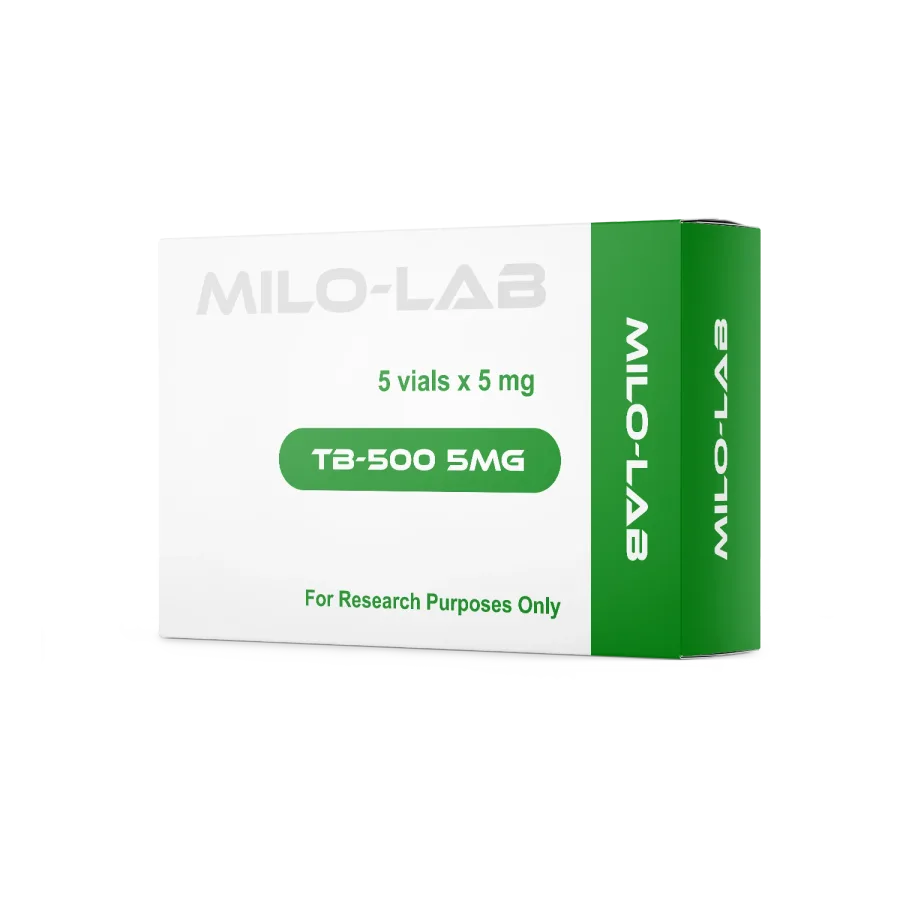
TB-500
TB-500 is a synthetic Thymosin Beta-4 fragment, a regenerative research peptide that drives systemic tissue repair via actin regulation.
Total Price
฿1600
Prefer Revolut, Wise or PayPal?
For research & laboratory use only. Not for human consumption.
Shipping: free within Thailand, ฿700 worldwide. Added at checkout. Delivery times & countries
Half-Life
~8-10 days (systemic circulation)
Administration Route
Subcutaneous injection
Systemic Tissue Repair
Actin sequestration enables cell migration to injury sites
Cardiac Muscle Healing
Strong evidence in cardiac ischaemia and post-MI repair
Anti-Inflammatory
Downregulates TNF-α and IL-6 at wound sites
Effect Timeline
Systemic anti-inflammatory effect; reduced stiffness
Improved mobility; cellular migration to damaged tissue
Functional healing of soft tissue; muscle repair accelerated
Full systemic tissue restoration; chronic injury improvement
Start — Week 1
Systemic anti-inflammatory effect; reduced stiffness
Week 2
Improved mobility; cellular migration to damaged tissue
Week 4
Functional healing of soft tissue; muscle repair accelerated
Week 8
Full systemic tissue restoration; chronic injury improvement
Mechanism of Action
Scientific Research
Expert Opin Biol Ther (2012)
Int Immunopharmacol (2023)
Expert Opin Biol Ther (2018)
Ann N Y Acad Sci (2007)
Why Researchers Choose TB-500
TB-500 is the research-grade Thymosin Beta-4 fragment used wherever systemic, body-wide tissue repair is the question rather than a single injury site. By regulating actin and mobilising regenerative cells through the circulation, it has become a reference peptide across several repair-focused models:
- Soft-tissue, tendon and ligament healing studies
- Cardiac repair and post-ischaemic cardiomyocyte survival research
- Wound healing and dermal regeneration models
- Angiogenesis and endothelial progenitor cell mobilisation
- Anti-inflammatory and cytokine-modulation investigations
- Neuro-repair work, including oligodendrocyte differentiation and myelination
TB-500 vs BPC-157: Complementary Repair Pathways
TB-500 and BPC-157 are among the most frequently co-administered repair peptides in research because they act through distinct mechanisms that overlap well:
| Mechanism | BPC-157 | TB-500 |
|---|---|---|
| Angiogenesis | VEGF upregulation | MMP-2, VEGF |
| Cell migration | FAK-Paxillin | Actin sequestration |
| Primary target | Local (injury site) | Systemic |
| Half-life | ~4 hours | ~8-10 days |
BPC-157 concentrates on local vascular and fibroblast activity at the injury site, while TB-500 mobilises repair cells throughout the body. Used together they cover both ends of the healing cascade. See the BPC-157 + TB-500 Combo for bundled pricing.
Reconstitution and Storage
Reconstitution: use bacteriostatic water; swirl gently until dissolved, do not shake. After reconstitution: store refrigerated, use within 30 days, and protect from direct light.
For research purposes only. Not for human consumption.
Dosing at a Glance
Route
Subcutaneous injection
Frequency
2x weekly (load), 1x weekly (maint.)
Typical research dose
2–5 mg
Opens the calculator with this peptide preselected. Research reference only.
Product FAQs
Stacks Well With
BPC-157
BPC-157 (Body Protective Compound) is a stable pentadecapeptide derived from human gastric juice, researched for tendon, gut and tissue repair.
Wolverine Stack
Wolverine Stack pairs BPC-157 and TB-500 (Thymosin Beta-4) in one recovery kit, combining local angiogenesis with systemic cell mobilisation for tissue repair.
Ipamorelin
Ipamorelin is a selective pentapeptide growth hormone secretagogue (GHRP) that triggers clean, pulsatile GH release without spiking cortisol or prolactin.
GHK-Cu
GHK-Cu (glycyl-L-histidyl-L-lysine) is a naturally occurring copper-binding tripeptide that drives collagen synthesis, skin repair and wound healing.
Used in Research Stacks
Recovery & Repair Stack
Related Products
BPC-157
BPC-157 (Body Protective Compound) is a stable pentadecapeptide derived from human gastric juice, researched for tendon, gut and tissue repair.
KPV
KPV (Lys-Pro-Val) is the anti-inflammatory C-terminal tripeptide of alpha-MSH, studied for gut, skin and immune-modulating research.
Ipamorelin
Ipamorelin is a selective pentapeptide growth hormone secretagogue (GHRP) that triggers clean, pulsatile GH release without spiking cortisol or prolactin.