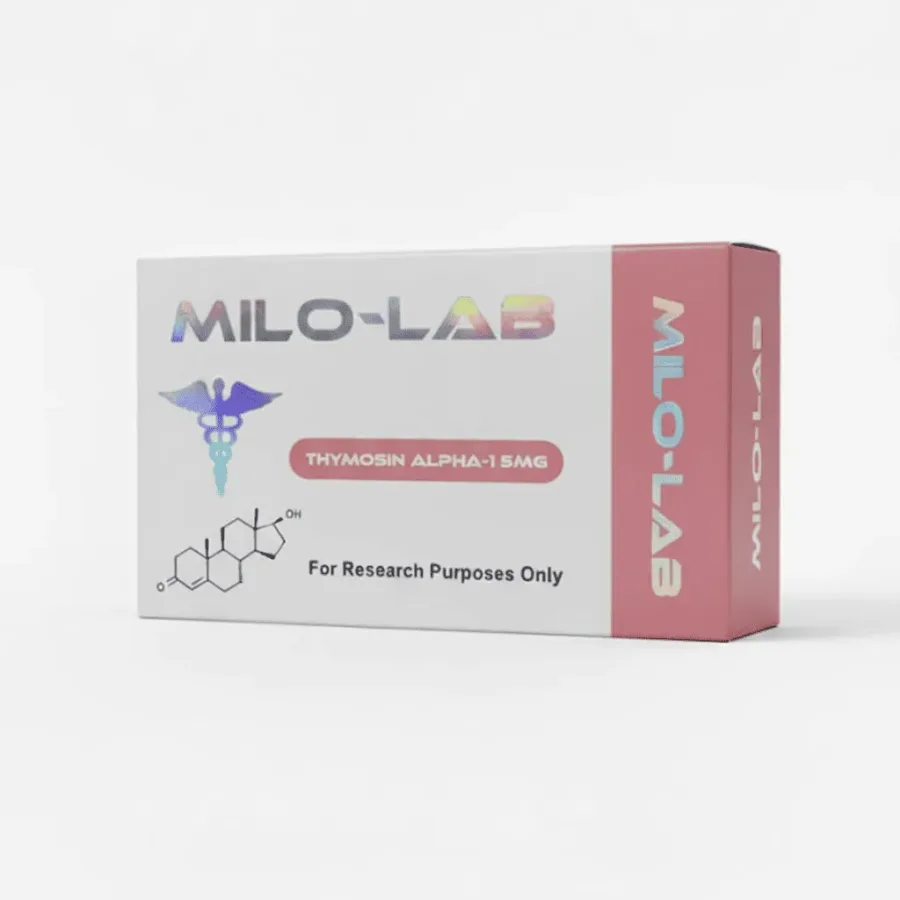
Thymosin Alpha-1
Thymosin Alpha-1 (Ta1) is a 28-amino-acid thymic immunomodulator peptide that activates TLR2/TLR9 signalling to prime innate and T-cell immunity.
Total Price
฿1100
Prefer Revolut, Wise or PayPal?
For research & laboratory use only. Not for human consumption.
Shipping: free within Thailand, ฿700 worldwide. Added at checkout. Delivery times & countries
Half-Life
~2 hours
Administration Route
Subcutaneous injection
Thymic Immunomodulator
Enhances T-cell maturation and NK cell cytotoxicity
Anti-viral Potency
Active against HBV, HCV, and studied in COVID-19 contexts
TLR9 Activation
Toll-like receptor 9 agonism drives innate immune priming
Effect Timeline
T-cell activity increases; NK cell cytotoxicity elevated
Immune surveillance improved; viral load reduction in models
Sustained immune enhancement; TLR signalling upregulated
Full immunomodulatory benefit; immune ageing markers reduced
Start — Week 2
T-cell activity increases; NK cell cytotoxicity elevated
Week 4
Immune surveillance improved; viral load reduction in models
Week 8
Sustained immune enhancement; TLR signalling upregulated
Week 12
Full immunomodulatory benefit; immune ageing markers reduced
Mechanism of Action
Scientific Research
World J Virol (2020)
Vitam Horm (2016)
Expert Opin Biol Ther (2018)
Why Researchers Choose Thymosin Alpha-1
Thymosin Alpha-1 (Ta1) is the most clinically validated thymic immunomodulator, and as a defined TLR2/TLR9 agonist it is a standard reference compound wherever targeted innate-immune priming is studied. The 5mg vial format and 25mg/50mg multi-vial kits cover both short pilot work and longer multi-week protocols.
- TLR2 and TLR9 agonism and pattern-recognition receptor signalling
- Antiviral immunity research in hepatitis B and hepatitis C models
- Cancer adjuvant and post-chemotherapy immune-reconstitution studies
- Sepsis and acute immune-dysregulation investigations
- Immunosenescence and thymic-involution intervention research
Mechanism: TLR2/TLR9 Activation and T-Cell Modulation
Ta1 was long assumed to act mainly by maturing T-cells inside the thymus. The 2007 Nature Medicine work by Romani and colleagues clarified a faster, upstream route: Ta1 is a direct TLR2 and TLR9 agonist on antigen-presenting cells.
TLR2 activation on dendritic cells and macrophages:
- Recognises bacterial lipoproteins and viral glycoproteins
- Signals through MyD88 to NF-kB, driving IL-12 output
- Advances dendritic cell maturation and antigen presentation
TLR9 activation:
- Recognises unmethylated CpG DNA, a bacterial and viral signature
- Initiates IFN-alpha/beta release (type I interferon response)
- Activates plasmacytoid dendritic cells
T-cell and NK effects:
- Steers naive T-cells toward Th1 effector differentiation
- Strengthens NK cell cytotoxic activity
- Upregulates MHC class I and II on antigen-presenting cells
Clinical Evidence Summary
Hepatitis B: Randomised trials report Ta1 combined with IFN-alpha outperforming interferon alone for HBeAg seroconversion and HBV DNA suppression.
Hepatitis C: Research indicates a higher sustained virological response (SVR) when Ta1 is added to pegylated interferon plus ribavirin.
Cancer adjuvant: Studies across lung, colorectal and hepatocellular carcinoma describe better immune reconstitution after chemotherapy, with some analyses suggesting a survival benefit.
Sepsis: The 2013 Zhao et al. Phase III trial in severe sepsis reported that Ta1 significantly lowered 28-day mortality (26.2% versus 35.0% in controls).
Immunosenescence Research
Endogenous Ta1 declines with age as the thymus involutes, shrinking from roughly 35g at puberty to under 5g by age 65. Ongoing research evaluates Ta1 as an immunosenescence intervention, with particular interest in restoring antiviral immunity and vaccine responsiveness in older populations.
Reconstitution and Storage
Reconstitution: use bacteriostatic water; swirl gently until fully dissolved, do not shake. After reconstitution: keep refrigerated, protect from direct light, and use within 28 days.
For research purposes only. Not for human consumption.
Dosing at a Glance
Route
Subcutaneous injection
Frequency
2x weekly
Typical research dose
1.6 mg
Opens the calculator with this peptide preselected. Research reference only.
Product FAQs
Customer Reviews
I picked up a horrible cold and flu which, for someone who doesn't drink or smoke and takes supplements regularly, had me stuck inside feeling awful — lungs clogged with mucus, nose blocked, sleep schedule off, and I ended up putting on around 8kg in 2 weeks. I reached out to Matt from Milo Lab about Thymosin after reading about it, and after using it three times every other day, it cleared the infection from my body within a week, without using anything else apart from my Semax (also from Milo Lab), which has been a big help for my anxiety. I run every day when fit, so being couch-bound for over 10 days was rough, but within 6 days I finished a double session run with no lingering symptoms. I'll be replacing most of my other supplements with Thymosin given how well it worked, and I've also felt it help reduce inflammation from my runner's hip. The service is also excellent, and Matt and his team are by far the best I've dealt with in Thailand in the 5 years I've been based in Phuket.