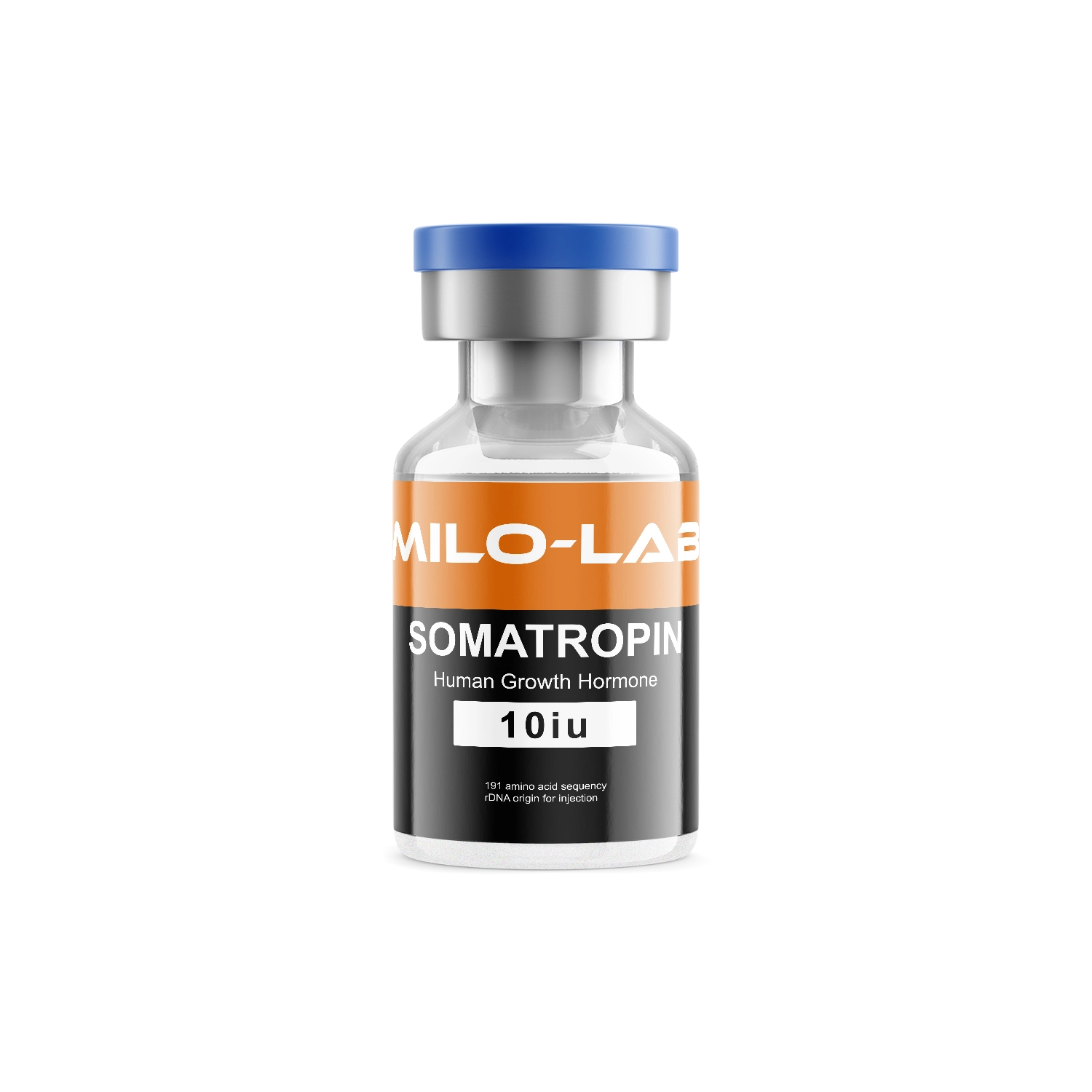
Somatropin
Somatropin is recombinant 191-amino-acid human growth hormone (rHGH), the reference compound for GH/IGF-1 axis, body-composition, and tissue-repair research.
Total Price
฿4600
Prefer Revolut, Wise or PayPal?
For research & laboratory use only. Not for human consumption.
Shipping: free within Thailand, ฿700 worldwide. Added at checkout. Delivery times & countries
Half-Life
~2-3 hours (subcutaneous; biological effect via IGF-1 is longer)
Administration Route
Subcutaneous injection after reconstitution
Recombinant 191aa HGH
Full-length somatropin identical to endogenous pituitary GH
Direct GH Delivery
Bypasses secretagogue pathways for precise exposure control
Reference Compound
Well-characterised pharmacology — common positive control in GH research
Effect Timeline
Baseline IGF-1 and body-composition markers recorded
Serum IGF-1 elevation typically observed in dose-response models
Connective-tissue and lean-mass endpoints assessed
Longer-term metabolic and recovery markers evaluated
Start — Week 1
Baseline IGF-1 and body-composition markers recorded
Weeks 2-4
Serum IGF-1 elevation typically observed in dose-response models
Weeks 4-8
Connective-tissue and lean-mass endpoints assessed
Weeks 8-12
Longer-term metabolic and recovery markers evaluated
Mechanism of Action
Scientific Research
J Clin Endocrinol Metab (2020)
Why Researchers Study Somatropin
Somatropin is recombinant human growth hormone (rHGH) — a 191-amino-acid polypeptide identical in sequence to endogenous pituitary GH, produced via rDNA expression. It is the reference compound for growth-hormone research, used to study the GH/IGF-1 axis, body-composition regulation, tissue repair, and metabolic signalling in controlled models.
Unlike GH secretagogues (which prompt the pituitary to release its own GH in pulses), somatropin delivers the hormone directly, giving researchers precise control over exposure and timing.
Mechanism of Action
Somatropin binds the transmembrane growth-hormone receptor (GHR) on target tissues. Receptor dimerisation activates the associated JAK2 tyrosine kinase, which phosphorylates STAT5; the pathway drives transcription of GH-responsive genes and, in hepatocytes, hepatic secretion of insulin-like growth factor 1 (IGF-1). IGF-1 mediates much of the downstream anabolic and regenerative signalling attributed to GH, while GH itself exerts direct lipolytic and insulin-modulating effects on adipose and muscle tissue.
Research Context
Investigational literature examines somatropin in the context of lean-mass and adipose-tissue regulation, connective-tissue and wound-repair models, bone-turnover markers, and IGF-1 dose-response. Its well-characterised pharmacology makes it a common positive control when benchmarking novel secretagogues and GHRH analogs.
Handling & Reconstitution
Supplied as a lyophilised powder. Reconstitute with bacteriostatic water, added slowly against the vial wall (never injected directly onto the pellet), and swirl gently rather than shake — HGH is a fragile protein and vigorous agitation can denature it. Store lyophilised vials refrigerated; keep reconstituted solution at 2–8 °C and protected from light.
Dosing at a Glance
Route
Subcutaneous injection after reconstitution
Frequency
per protocol
Typical research dose
2–8 IU
Opens the calculator with this peptide preselected. Research reference only.
Product FAQs
Customer Reviews
came quickly, ordering and payment easy
Quality GH. Packed well and lightning fast shipping so no worries about temperature damage. Always happy with MILO-LAB