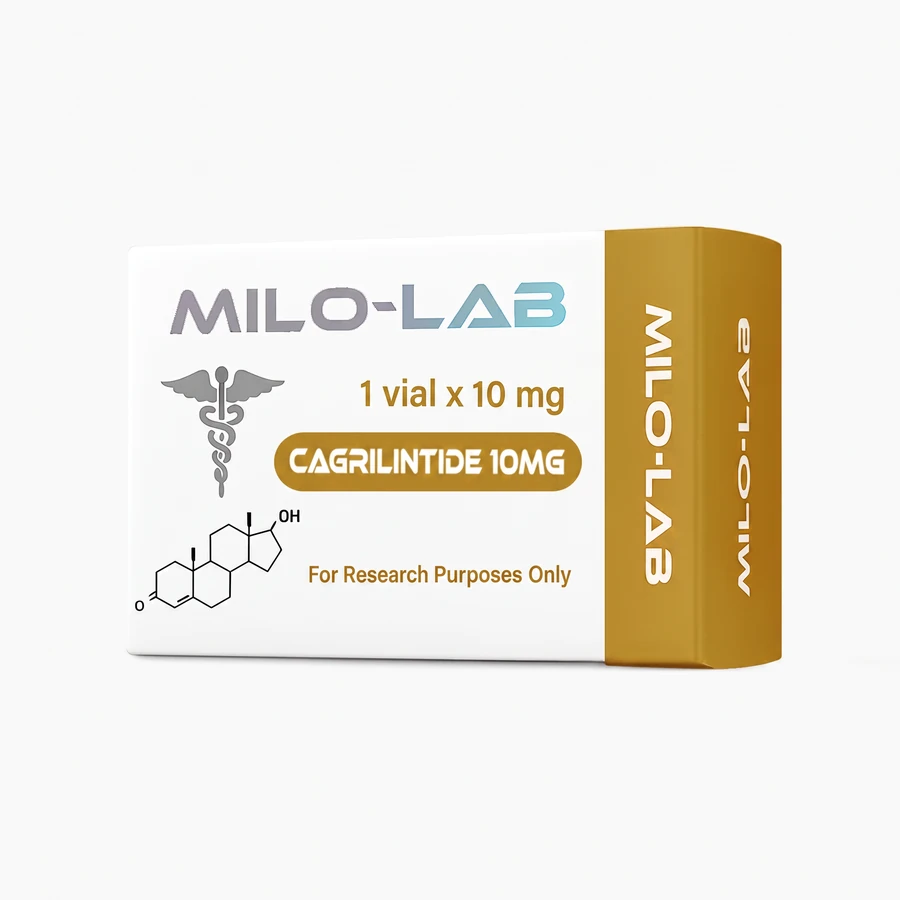
Cagrilintide
Cagrilintide is a long-acting amylin analogue for once-weekly research use, studied for satiety signalling alone and combined with semaglutide.
Back in stock soon
This size is temporarily sold out. Pick another size, or ask us and we will let you know as soon as it is back.
Prefer Revolut, Wise or PayPal?
For research & laboratory use only. Not for human consumption.
Shipping: free within Thailand, ฿700 worldwide. Added at checkout. Delivery times & countries
Half-Life
Long-acting; exposure supports once-weekly subcutaneous dosing
Administration Route
Subcutaneous injection
Amylin Receptor Agonist
Non-incretin satiety pathway, separate from GLP-1
Once-Weekly Dosing
Albumin-binding lipid side chain extends exposure
10.8% in Phase 2
Cagrilintide 4.5mg at 26 weeks vs 3.0% on placebo
Effect Timeline
Dose-escalation phase begins; gastric emptying slows
Titration continues; appetite-related endpoints start separating from placebo
Maintenance dosing; nausea reports typically decline after the titration phase
Phase 2 primary endpoint: up to 10.8% mean weight reduction at 4.5mg
Start — Week 1–2
Dose-escalation phase begins; gastric emptying slows
Week 4
Titration continues; appetite-related endpoints start separating from placebo
Week 12
Maintenance dosing; nausea reports typically decline after the titration phase
Week 26
Phase 2 primary endpoint: up to 10.8% mean weight reduction at 4.5mg
Mechanism of Action
Scientific Research
New England Journal of Medicine (2025)
Lancet Diabetes Endocrinol (2026)
Why Researchers Choose Cagrilintide
Cagrilintide is the amylin analogue furthest along in clinical development and the only one with published phase 3 data. It is studied wherever satiety signalling outside the incretin system is the question:
- Amylin and calcitonin receptor pharmacology in appetite regulation
- Non-incretin weight-management protocols and mechanism comparisons
- Additive-effect research alongside GLP-1 agonists (the CagriSema combination)
- Gastric-emptying and meal-termination studies
- Dose-response and titration work across the 0.3mg to 4.5mg range
How Cagrilintide Works
Amylin is co-secreted with insulin by pancreatic beta cells and signals meal termination through amylin and calcitonin receptor complexes in the area postrema and hypothalamus. Native amylin aggregates readily and clears within minutes, which makes it unusable as a research compound. Cagrilintide is an acylated analogue engineered around both problems: the sequence resists aggregation, and a lipid side chain binds albumin to extend exposure enough for once-weekly subcutaneous dosing.
The pathway matters as much as the potency. Amylin receptor signalling reduces food intake and slows gastric emptying without acting on the GLP-1 receptor, so its effect sits alongside rather than on top of incretin pharmacology. That separation is why the combination with semaglutide is studied as an additive design rather than a dose escalation.
Trial Evidence
Phase 2 monotherapy (Lancet, 2021). In a 26-week dose-finding trial across ten countries, 706 participants received once-weekly cagrilintide between 0.3mg and 4.5mg. Mean weight reduction ranged from 6.0% to 10.8% versus 3.0% on placebo. The 4.5mg arm also exceeded once-daily liraglutide 3.0mg (10.8% vs 9.0%). Gastrointestinal events, mainly nausea, were the most frequent adverse events.
REDEFINE 1 (New England Journal of Medicine, 2025). The phase 3a trial randomised 3,417 adults to cagrilintide 2.4mg plus semaglutide 2.4mg, either compound alone, or placebo over 68 weeks. The combination arm reached a mean body-weight change of -20.4% versus -3.0% on placebo. Gastrointestinal adverse events affected 79.6% of the combination group versus 39.9% on placebo, mostly transient and mild to moderate.
Cagrilintide vs GLP-1 and Multi-Agonist Peptides
| Cagrilintide | Semaglutide | Retatrutide | |
|---|---|---|---|
| Receptor target | Amylin / calcitonin | GLP-1 | GLP-1, GIP, glucagon |
| Pathway | Non-incretin satiety | Incretin | Incretin + energy expenditure |
| Dosing interval | Once weekly | Once weekly | Once weekly |
| Studied in combination | Yes, with semaglutide | Yes, with cagrilintide | Monotherapy |
Cagrilintide is the compound of interest when the research question concerns amylin signalling itself, or when an additive mechanism to an existing GLP-1 protocol is being modelled. Other long-acting amylin analogues (eloralintide, petrelintide, MET-233i, AZD6234) are in earlier-stage trials, and amycretin combines amylin and GLP-1 activity in a single molecule.
Cagrilintide Dosing Protocol
Titration: phase 2 escalated once weekly over up to 6 weeks across the 0.3, 0.6, 1.2, 2.4 and 4.5mg steps. Phase 3 combination work used 2.4mg alongside semaglutide 2.4mg.
Reconstitution and Storage
Reconstitution: use bacteriostatic water (1 to 2ml per vial); swirl gently until fully dissolved, do not shake. After reconstitution: keep refrigerated (2-8°C), use within 28 days, do not freeze, and protect from direct light.
For research purposes only. Not for human consumption.
Product FAQs
Stacks Well With
Related Products
Retatrutide
Retatrutide (LY3437943) is Eli Lilly's investigational triple-receptor peptide targeting GLP-1, GIP and glucagon, with up to 24.2% weight loss in Phase 2.
Semaglutide
Semaglutide (Ozempic) is a long-acting GLP-1 receptor agonist peptide that suppresses appetite and supports weight loss, with up to 14.9% reduction in STEP-1.
Tirzepatide
Tirzepatide (Mounjaro) is a dual GIP and GLP-1 receptor agonist peptide that lowers blood sugar and drives weight loss, with up to 22.5% loss in trials.